In the middle of the project
Afterwards it can only be explained.
A poor margin after the closing invoice is an insight. The same figure in the third month is a decision.
The problem in project work is rarely that a project loses money. The problem is that it is noticed too late. That is why the arithmetic does not belong at the end but in the middle.
You set up your account yourself – registration opens in a new tab and needs a moment the first time. If you would rather know first whether we are a match, send us an enquiry, no obligation.
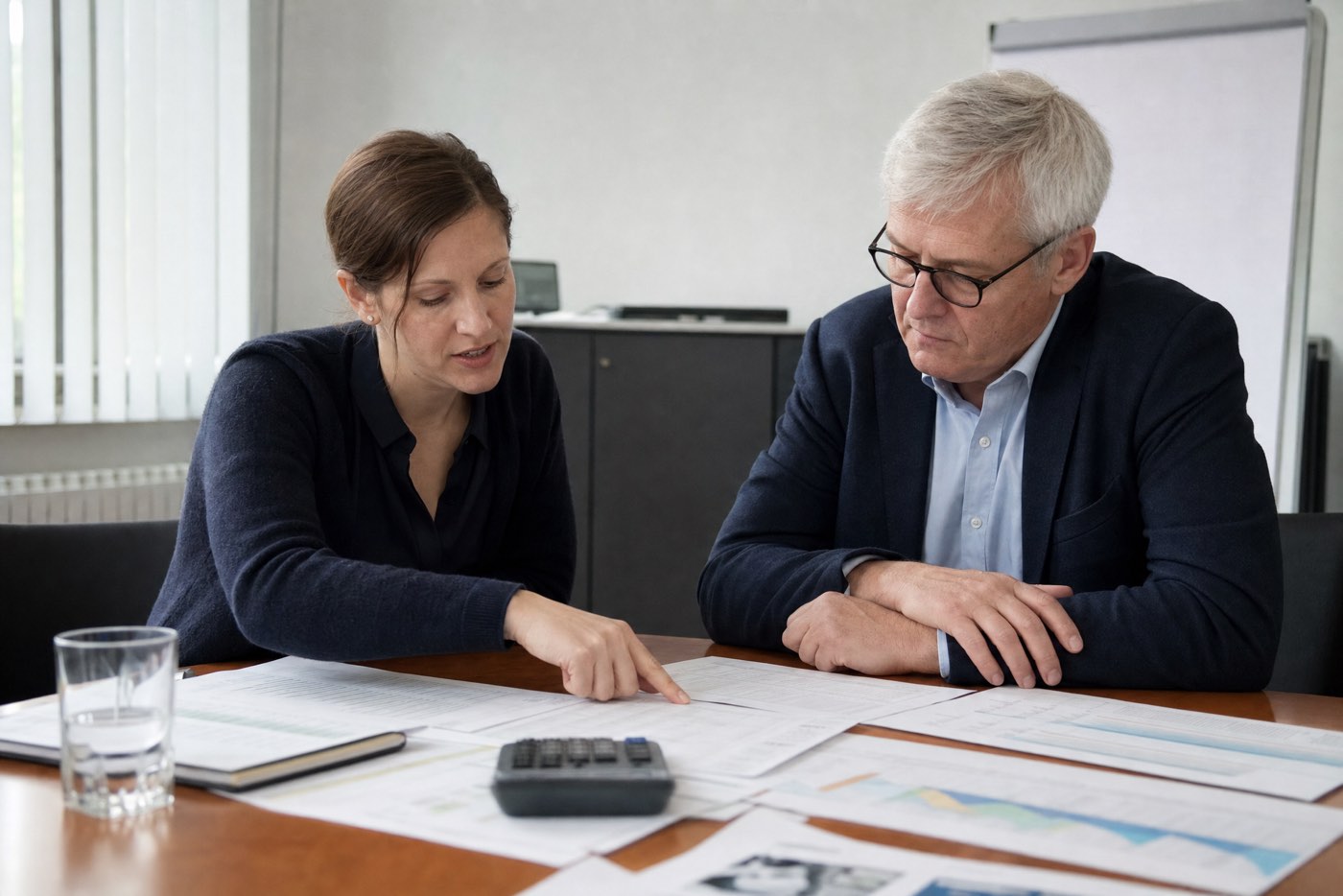 Stock photoCorrect course while there is still a course to correct.
Jobtura · Costing → Project → Hours
Stock photoCorrect course while there is still a course to correct.
Jobtura · Costing → Project → Hours
Three everyday steps that cost you time today, and how they run with Jobtura:
A poor margin after the closing invoice is an insight. In the third month it is a decision.
Costs and revenue come together on the project while it runs, expected and actual, each of them cumulative as well.
A calculation over the margin shows which sales price yields which gross profit. Decided beforehand, not explained afterwards.
The purchase order goes to the supplier and the incoming invoice comes out of it. Order price and invoice price sit side by side.
A large undertaking is broken up. Every section carries its budget and its hours instead of disappearing into the total.
At the start there is the costing. Which services are you selling, which material do you need, how many staff hours do you expect, what has to be bought in, which equipment and vehicles are in use.
A calculation over the margin shows which sales price yields which gross profit. Whether the order adds up is therefore decided before you commit and not afterwards.
A project then bundles any number of jobs and brings costs, revenue and dates together across them. The project manager is assigned to it, and it runs over weeks and across several trades.
Larger undertakings are broken into subgroups. Every section carries its own budget and its own hours, so that a weak section does not disappear into the total.
Reality takes no interest in the original costing. Material gets more expensive, staff need more hours, an extra journey is added, a subcontractor sends a higher invoice. At the same time another part runs better than expected.
That is why it is not enough to work out revenue minus costs after the project. Staff time is recorded or taken over from the planned jobs and flows in continuously.
Whatever you buy in for the project hangs on the same job. The purchase order goes to the supplier, the incoming invoice is created from it, and the unit price from the order sits next to the one from the incoming invoice. The difference is therefore not a guess.
Revenue arises through invoices and partial invoices, and open items stay visible. What has already been invoiced and what can still be invoiced sits on the job.
On the job the figures sit side by side: expected costs and actual, revenue, budget and contribution margin, each of them cumulative as well. Step by step the costing therefore becomes a reckoning.
The project manager reads from it whether the project works operationally. Management reads the same figures and asks whether it works commercially. Both look at the same state.
A look at the detail explains why a project runs the way it runs. Perhaps the material was badly costed while the labour came in better than planned. What matters is not that every section is right but that the deviation becomes visible early.
Because after the closing invoice a poor margin can only be explained. While the project runs, something can be done about it.
Entered once, usable everywhere. No double entry.
And it carries on from there on the same job: quotes can be signed digitally, deposit, interim and final invoices follow from it, incoming payments and reminders hang on it, and at the end the data goes to the accounts.
Where spreadsheets stop, Jobtura carries on: stock levels, picking and scanning are built in. No extra tool needed.
Packing lists straight from the order. Tick off line by line, so nothing is forgotten and nothing is packed twice.
A live overview in the warehouse: which orders are due, what is packed, what is missing, on a screen right there.
Barcode and QR scanning by smartphone: book equipment, record withdrawals, check returns, in seconds.
Five quick questions, an answer straight away – then we both know whether this is a match.
Jobtura is not theory software. It has been in use for years with rental businesses, event technicians and service providers across Germany, built with the people who work with it every day.
 Stock photo
A poor margin after the closing invoice is an insight. The same figure in the third month is a decision.
Jobtura comes in two forms: as full rental software for businesses with a warehouse and equipment fleet, and as a lean cloud entry for small teams.
The full ERP software for rental, sales & service. That is this page.
Jobtura as a Service , the lean cloud entry for small teams.
And the two belong together: JaaS also works as an app alongside Sales & Rent. You can just as well use only the app, or only Sales & Rent. And where the software runs is your call: in our cloud, on your own server, or on a machine in your own building.
ERP and inventory software for Rental · Sales · Service. You start lean with what you need and add more as you grow: