In the bar chart
Two sites, one person.
Conflicts do not arise when you plan but when you commit. Better that they show up beforehand.
Two technicians, a driver, a fitter with a particular qualification, plus a vehicle and a slot in the workshop. In Jobtura it is not the calendar that gets planned but the order.
You set up your account yourself – registration opens in a new tab and needs a moment the first time. If you would rather know first whether we are a match, send us an enquiry, no obligation.
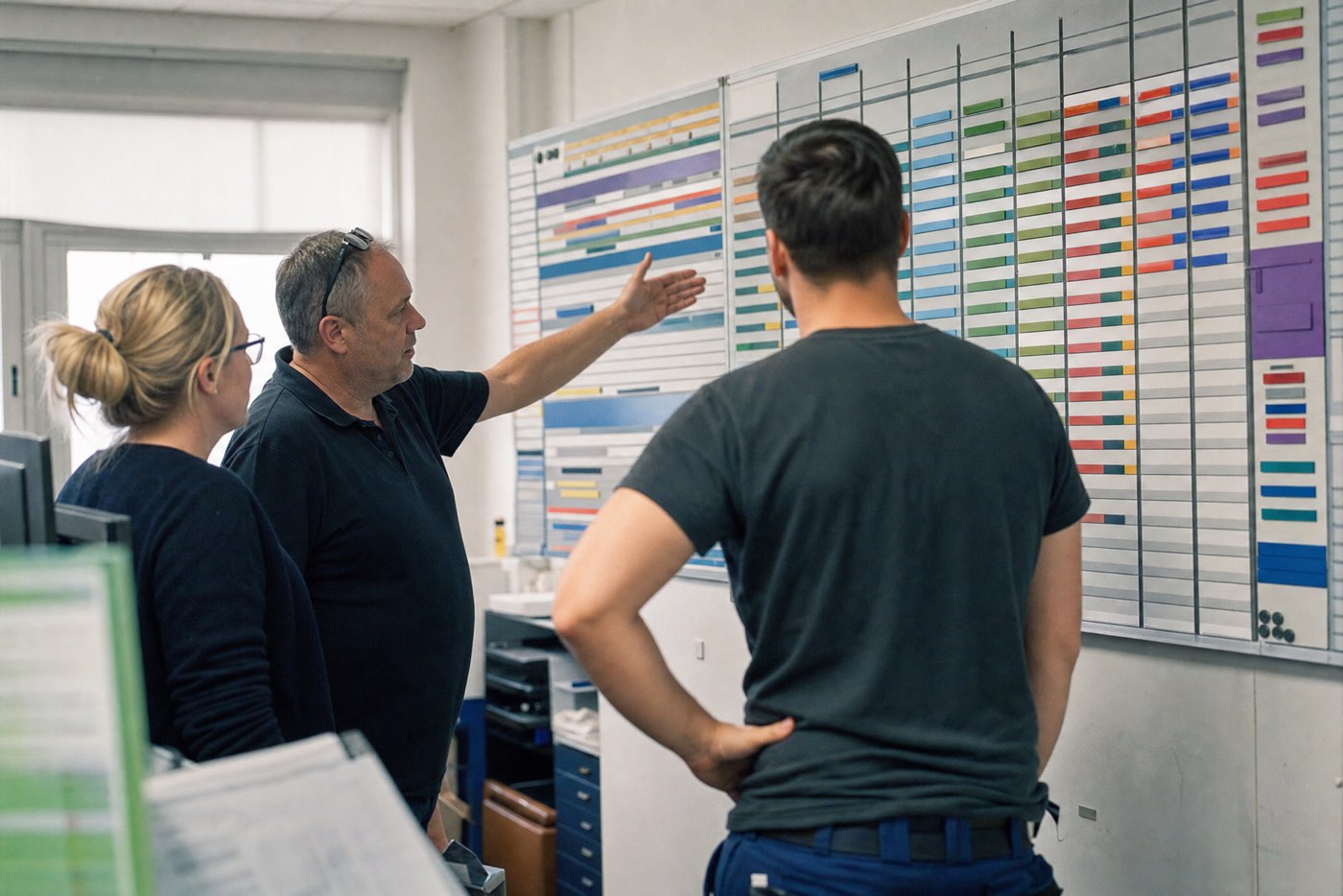 Stock photoFirst the question of what the order needs. Then the plan.
Jobtura · Requirement → Qualification → Resources
Stock photoFirst the question of what the order needs. Then the plan.
Jobtura · Requirement → Qualification → Resources
Three everyday steps that cost you time today, and how they run with Jobtura:
It is not the calendar that gets planned but the order, and everything it needs in order to happen.
The bar chart lays jobs and line items across time. Overlaps become visible before two jobs need the same person.
Times are recorded or taken over from planned jobs. A service is a line item type of its own, by time or as a flat rate.
Qualifications and availability govern the dispatch. Approved absences take effect on staffing immediately.
What is neither goods nor person gets scheduled too: rooms, areas, vehicles and tools sit in the same overview.
An order rarely consists of articles alone. Somebody has to carry it out, and usually that somebody needs something else as well. Suddenly a stock level is no longer enough, and stock management becomes resource planning.
Jobtura therefore treats resources not as isolated calendars but as part of the order. The first question is not who is free on Tuesday, but what this order needs in order to actually happen.
Staff carry qualifications and availabilities. A job might call for a driving licence, might call for particular skill, might simply call for somebody who is not already on another order at that time. Qualifications and availability therefore govern the dispatch.
Alongside people, articles are scheduled, and alongside those what is neither goods nor person: rooms, areas, vehicles and tools are available as resources and appear in the same availability overview.
One person cannot be on two building sites at once. One vehicle cannot be on two routes. One individual machine cannot be at two customers. These are simple truths that turn into a surprisingly complicated plan as a company grows.
The bar chart lays jobs and line items across time, so overlaps become visible before they become a problem. Availability per article and day flags overbooking, and approved absences take effect on the dispatch immediately.
That way the dispatch answers a question that otherwise only gets answered on the day: can you commit without taking it back later.
Every company needs different resources. An event technician needs equipment, an exhibition builder needs staff, material, vehicles and production time, a service company needs a technician with parts and a service vehicle. Almost every operating company needs several of them at once, and that is exactly where a calendar becomes a dispatch.
Once the order is planned, everyone involved knows when and where they are needed. Material is prepared to match, vehicles are dispatched, and the execution follows the same plan.
Times are recorded or taken over from the planned jobs. A service is a line item type of its own and is valued by time or as a flat rate, mixed with goods in the same job.
The target comes from working time model, shift and public holiday calendar. Holiday, sickness and other absences are requested, checked and approved, and they act back on the same plan.
In the end there is not only who was scheduled, but who was actually there, how long the job took and what it cost. People, equipment, vehicles, rooms, material and time come together in the same calculation.
Entered once, usable everywhere. No double entry.
And it carries on from there on the same job: quotes can be signed digitally, deposit, interim and final invoices follow from it, incoming payments and reminders hang on it, and at the end the data goes to the accounts.
Where spreadsheets stop, Jobtura carries on: stock levels, picking and scanning are built in. No extra tool needed.
Packing lists straight from the order. Tick off line by line, so nothing is forgotten and nothing is packed twice.
A live overview in the warehouse: which orders are due, what is packed, what is missing, on a screen right there.
Barcode and QR scanning by smartphone: book equipment, record withdrawals, check returns, in seconds.
Five quick questions, an answer straight away – then we both know whether this is a match.
Jobtura is not theory software. It has been in use for years with rental businesses, event technicians and service providers across Germany, built with the people who work with it every day.
 Stock photo
Conflicts do not arise when you plan but when you commit. Better that they show up beforehand.
Jobtura comes in two forms: as full rental software for businesses with a warehouse and equipment fleet, and as a lean cloud entry for small teams.
The full ERP software for rental, sales & service. That is this page.
Jobtura as a Service , the lean cloud entry for small teams.
And the two belong together: JaaS also works as an app alongside Sales & Rent. You can just as well use only the app, or only Sales & Rent. And where the software runs is your call: in our cloud, on your own server, or on a machine in your own building.
ERP and inventory software for Rental · Sales · Service. You start lean with what you need and add more as you grow: