At the device
A deadline does not rely on memory.
What has to be checked and at what interval sits on the device as a template. What is due and overdue appears in the overview before anyone goes looking for it.
You deliver a device and are responsible for it for the next ten or twenty years. In Jobtura the deadline, the report, the repair and the invoice hang on that exact device and not on a list beside it.
You set up your account yourself – registration opens in a new tab and needs a moment the first time. If you would rather know first whether we are a match, send us an enquiry, no obligation.
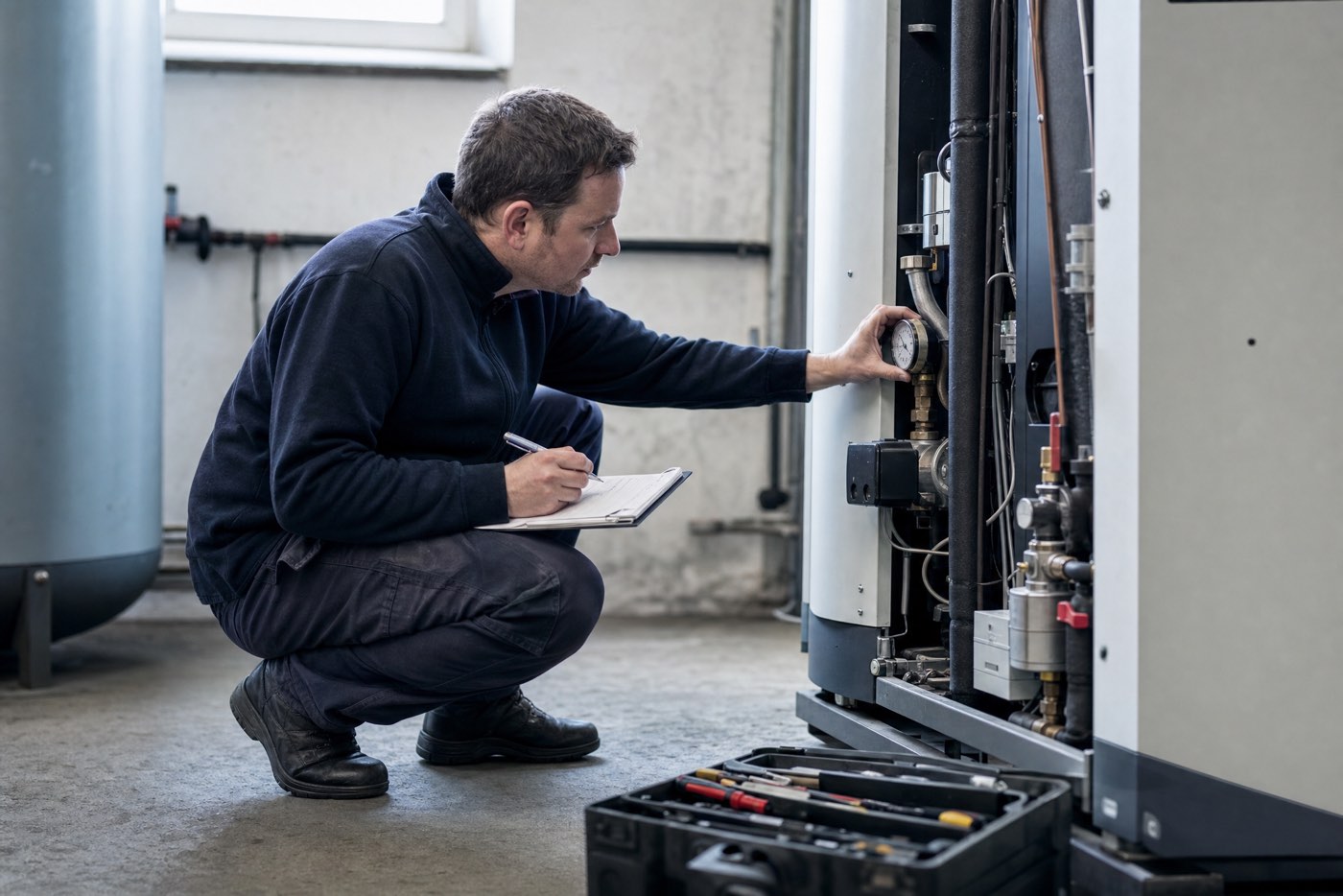 Stock photoOne device, one life history, no list beside it.
Jobtura · Item → Inspection template → Due date
Stock photoOne device, one life history, no list beside it.
Jobtura · Item → Inspection template → Due date
Three everyday steps that cost you time today, and how they run with Jobtura:
Ten identical machines are one article commercially and ten objects for service.
Due and overdue devices are flagged before the deadline passes. Where usage is what matters, running hours count instead of the calendar.
Every inspection carried out leaves evidence on the device: what was checked, with what result and by whom.
Fault pattern and resolution stay with the case. The device can be blocked so that it no longer appears as available in any order.
Stock management distinguishes quantity from individual device. Installation, maintenance, repair and part replacement hang on the serial number.
Ten identical machines are commercially the same article. For service they are ten different objects. Stock management therefore distinguishes between quantity and individual device, and the individual device can be followed across its whole life history.
On the device hang serial number, customer, location, technical details and documents. From delivery onwards a history builds up: installation, maintenance, inspection, part replacement, fault, repair. Every event stays where it belongs.
Movements between warehouse, site and workshop stay traceable. Where a device currently is does not have to be asked.
That way nobody has to work out years later what was actually done back then. The information hangs on the device.
The basis is an inspection template. It defines which characteristics have to be checked, which values are permissible and at what interval the check is due. A device can carry several of them when different checks fall due at different rhythms.
Inspection deadlines are monitored, not remembered. Due and overdue devices are flagged before the deadline passes, together with open jobs and follow-ups. Instead of a hand-kept list, the device base itself generates the work of the coming weeks.
For devices that depend on usage it is not the calendar that counts but the running hours. They sit on the device and are taken into account for the due date.
Who takes the job follows qualification and availability. Appointments can be assigned to staff or user groups, so responsibilities can be mapped by territory.
Every inspection carried out produces a report with result, inspector and date. It hangs on the device and stays there as evidence of what was checked, with what result and by whom.
If an inspection fails, the fault pattern and the way it was resolved can be recorded. The device can be blocked so that it appears as available in no further order, and a replacement device takes its place. The parts needed are procured through purchasing and assigned to the job.
Afterwards the work delivered flows back into the commercial job. Material was consumed, working time was spent. Billing is a flat rate or by actual effort, depending on what was agreed with the customer.
For your own hire fleet Jobtura therefore knows not only the revenue of a device but also its costs: purchase, maintenance, repairs, parts, downtime. At some point that answers the real question, namely whether it is still worth keeping this device at all.
Entered once, usable everywhere. No double entry.
And it carries on from there on the same job: quotes can be signed digitally, deposit, interim and final invoices follow from it, incoming payments and reminders hang on it, and at the end the data goes to the accounts.
Where spreadsheets stop, Jobtura carries on: stock levels, picking and scanning are built in. No extra tool needed.
Packing lists straight from the order. Tick off line by line, so nothing is forgotten and nothing is packed twice.
A live overview in the warehouse: which orders are due, what is packed, what is missing, on a screen right there.
Barcode and QR scanning by smartphone: book equipment, record withdrawals, check returns, in seconds.
Five quick questions, an answer straight away – then we both know whether this is a match.
Jobtura is not theory software. It has been in use for years with rental businesses, event technicians and service providers across Germany, built with the people who work with it every day.
 Stock photo
What has to be checked and at what interval sits on the device as a template. What is due and overdue appears in the overview before anyone goes looking for it.
Jobtura comes in two forms: as full rental software for businesses with a warehouse and equipment fleet, and as a lean cloud entry for small teams.
The full ERP software for rental, sales & service. That is this page.
Jobtura as a Service , the lean cloud entry for small teams.
And the two belong together: JaaS also works as an app alongside Sales & Rent. You can just as well use only the app, or only Sales & Rent. And where the software runs is your call: in our cloud, on your own server, or on a machine in your own building.
ERP and inventory software for Rental · Sales · Service. You start lean with what you need and add more as you grow: