At the rack
Ten identical machines are ten machines.
Commercially one article, operationally ten objects. One is new, one is in repair, one is due for inspection next week.
Classic stock management gives you a number: twenty-four units. As soon as several people work in the warehouse and material moves between order, customer and locations, that is no longer enough.
You set up your account yourself – registration opens in a new tab and needs a moment the first time. If you would rather know first whether we are a match, send us an enquiry, no obligation.
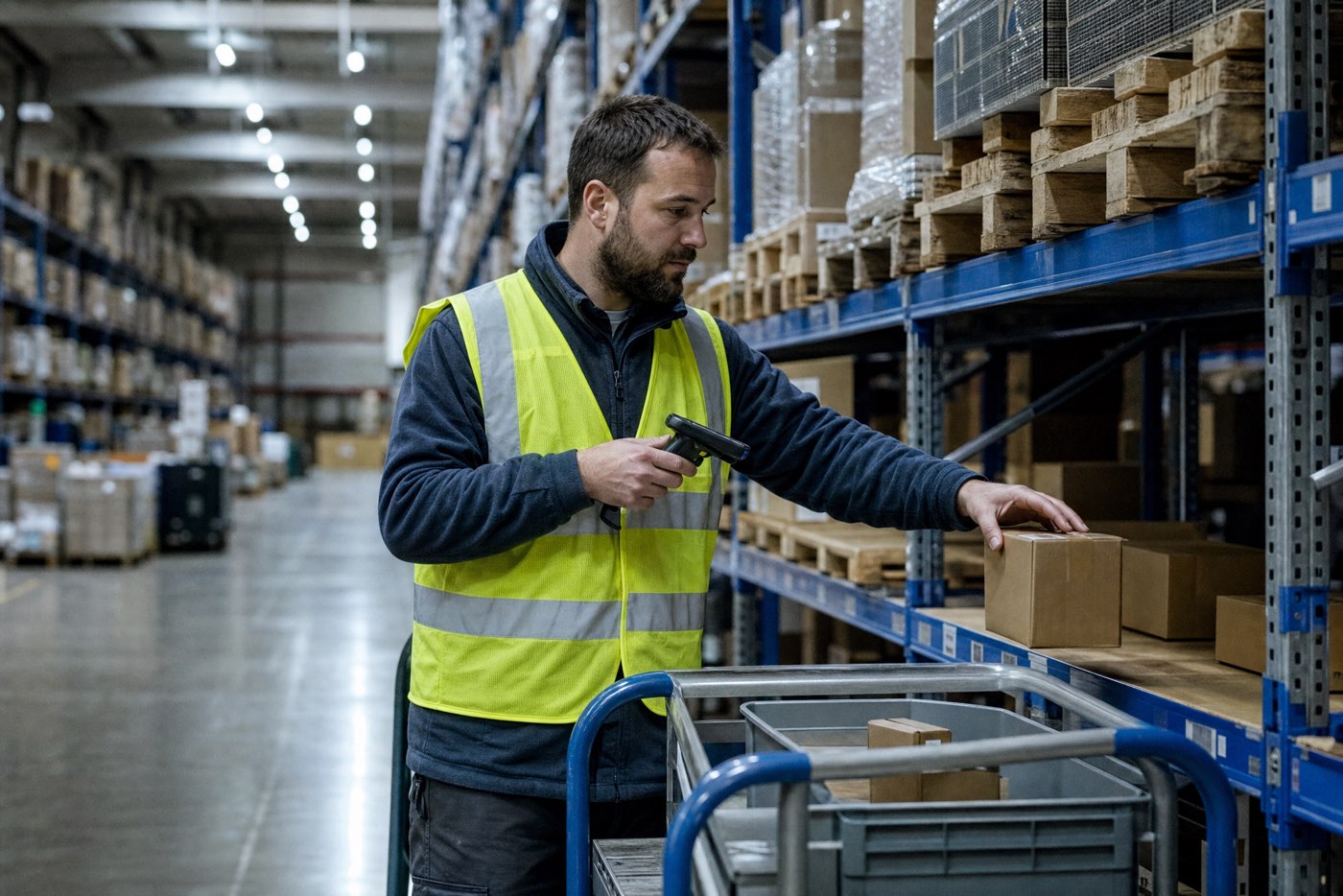 Stock photoQuantity, place and individual unit, not just the number.
Jobtura · Goods receipt → Bin location → Picking
Stock photoQuantity, place and individual unit, not just the number.
Jobtura · Goods receipt → Bin location → Picking
Three everyday steps that cost you time today, and how they run with Jobtura:
The number alone does not help if nobody knows where it lies and which unit it is.
For individually kept devices the location applies per unit, for quantity articles the quantity per location. Several warehouses can be kept.
Counting runs against the target stock and is captured by barcode. Discrepancies and wrongly stored articles become visible.
Goods receipt, picking and return all run by scan. A scan code can be taught once, after which the scanner finds the unit.
Stock arises from movements. Whatever moves between locations or sits on a job for a while stays traceable.
Stock management distinguishes between quantity articles and individually kept devices. Nobody counts screws one by one, a generator yes.
Ten identical machines are commercially the same article and operationally ten different objects. One is new, one has been out to customers twenty times, one is in repair, one is due for inspection next week, one has just been transferred.
Individually kept articles therefore carry their serial number, and individual tracking runs by serial number or barcode. A scan code can be taught once, after which the scanner finds the unit without searching.
For individually kept devices the bin location applies per unit, for quantity articles the quantity per location.
Several warehouses can be kept, and within a warehouse the article sits on a bin location with its own number. That way it is known not only that something exists but where it should be.
Stock arises from receipts, issues and transfers. Material moves between locations, devices sit on a job for a while, others stand at a customer or are on the way back. A stock figure therefore becomes a history of movement.
Goods receipt records what was actually delivered. For quantity articles the available stock rises, and for serialised devices it is additionally recorded which unit arrived.
Picking runs line by line and is confirmable by barcode. Whatever leaves the warehouse hangs on the job, and the return records what came back.
The scan brings the digital record together with the reality on the rack. Recording happens where it happens, not afterwards at a desk from memory.
RFID can speed the process up further. Where a scanner deliberately records single objects, it can, depending on the technology used, identify larger quantities of tagged objects more quickly, for instance at issue, return or stocktake.
The stocktake runs with count sheets and barcode capture against the target stock. Discrepancies become visible, wrongly stored articles show up, and the value of the warehouse can be evaluated as at the reporting date.
In the end the warehouse answers not only how much is there. It answers where it lies, which unit it is and what last happened to it.
Entered once, usable everywhere. No double entry.
And it carries on from there on the same job: quotes can be signed digitally, deposit, interim and final invoices follow from it, incoming payments and reminders hang on it, and at the end the data goes to the accounts.
Where spreadsheets stop, Jobtura carries on: stock levels, picking and scanning are built in. No extra tool needed.
Packing lists straight from the order. Tick off line by line, so nothing is forgotten and nothing is packed twice.
A live overview in the warehouse: which orders are due, what is packed, what is missing, on a screen right there.
Barcode and QR scanning by smartphone: book equipment, record withdrawals, check returns, in seconds.
Five quick questions, an answer straight away – then we both know whether this is a match.
Jobtura is not theory software. It has been in use for years with rental businesses, event technicians and service providers across Germany, built with the people who work with it every day.
 Stock photo
Commercially one article, operationally ten objects. One is new, one is in repair, one is due for inspection next week.
Jobtura comes in two forms: as full rental software for businesses with a warehouse and equipment fleet, and as a lean cloud entry for small teams.
The full ERP software for rental, sales & service. That is this page.
Jobtura as a Service , the lean cloud entry for small teams.
And the two belong together: JaaS also works as an app alongside Sales & Rent. You can just as well use only the app, or only Sales & Rent. And where the software runs is your call: in our cloud, on your own server, or on a machine in your own building.
ERP and inventory software for Rental · Sales · Service. You start lean with what you need and add more as you grow: