What sets Jobtura apart from other software providers?
We do not simply want to sell software. We want to help companies organise their business processes better in the long term, work more economically and make better-founded decisions.
What sets us apart
Jobtura in a nutshell
Software that adapts to you. Not the other way round.
We do not want to be the right software for everyone. We want to offer our customers the best possible solution.
That is why we combine comprehensive standard software with individual adaptability, personal support and long-term partnership.
Our solutions range from classic order and inventory management through resource planning, rental processes, mobile applications and cash registers all the way to comprehensive business management.
In doing so, we offer our customers a high degree of freedom: cloud, on-premises or hybrid. Desktop, web or app. Subscription or perpetual licence.
We analyse business processes before we implement larger projects, and we can extend our software with custom developments where needed.
We are particularly strong at connecting operational and commercial processes. With integrated point-of-sale systems, extensive invoicing options, interfaces to financial accounting systems such as DATEV, SAP or BMD, depending on the system and project requirements, and real-time business analyses, we make the financial situation of a company transparent.
Margins and contribution margins can be determined as early as the quotation stage. Provided the data is kept complete and up to date, business performance can be tracked on an ongoing basis instead of relying solely on delayed reports.
We are not the cheapest provider, and we do not want to be. Our aim is a powerful, economically sensible solution that grows with the requirements of our customers.
We do not want to win as many customers as possible. We want to work successfully with our customers for as many years as possible.
Our approach
What does Jobtura do differently? The background in detail.
The market for business software is large. There are countless providers and a wide variety of products, and almost every piece of software promises to make day-to-day work simpler, faster and more efficient. Whether inventory management, order management, resource planning, rental software, point-of-sale system or ERP solution: there is now a suitable application for almost every business challenge.
But how do these solutions actually differ? And why should a company choose Jobtura in particular?
That is an entirely fair question. And we want to answer it as clearly as we can.
Because we follow an approach that differs from many traditional software providers in a number of essential respects.
We do not want to be the right software for everyone. We want to offer our customers the best possible solution.
At first, that sounds like a small difference. In fact, though, this principle shapes almost everything we do: how we develop our products, which customers we look after, how we approach projects and which technical and commercial options we offer.
We do not want to be the right software for everyone. We want to offer our customers the best possible solution.
Long-term partnership
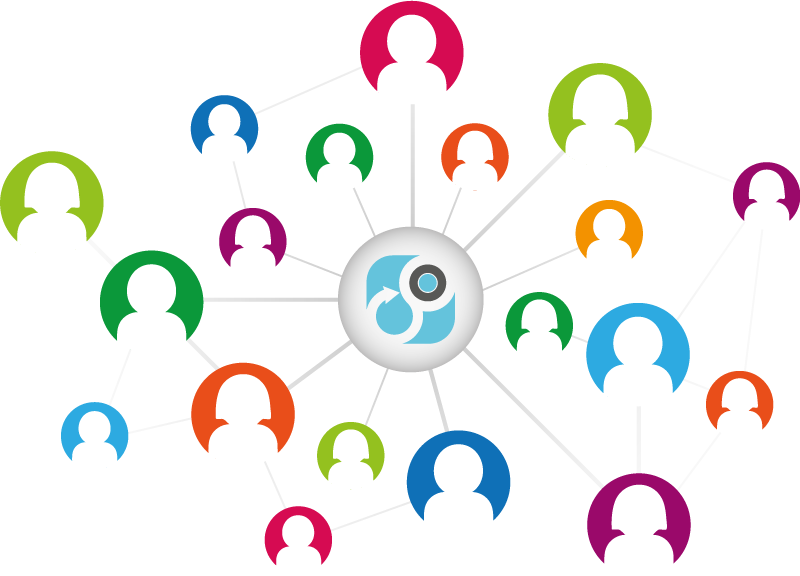
We rely on long-term partnerships rather than volume.
Our goal is not to win as many customers as possible in as short a time as possible. We want to work with companies that use our software successfully over the long term.
To that end, we deliberately focus on a select group of customers whom we can look after to a high standard. We want to know our customers, understand their business models and know what requirements they place on our software.
We do not want to win as many customers as possible. We want to work successfully with our customers for as many years as possible.
Of course, we invest continuously in documentation, automation, training materials and ways for our customers to work and solve problems independently. Good software should be as intuitive to use as possible and answer many questions before they even arise.
But we also believe that good service should not consist solely of a help portal and a ticket system.
When it matters, we are personally available. We engage with our customers’ real challenges and look for solutions together.
We do not regard the introduction of business software as a short-term deal. Anyone who decides on a central business solution is making a decision that often lasts for many years. Data is migrated, employees are trained, business processes are set up and entire areas of the business are connected to the software.
A step like this creates responsibility on both sides.
That is why we do not want to sell software that has to be replaced again after two years. We want to create solutions that can be used successfully for ten years, twenty years or, ideally, considerably longer.
We do not want to win as many customers as possible. We want to work successfully with our customers for as many years as possible.
Individual adaptability
Our software adapts to the company. Not the other way round.
Every company works differently.
Even within the same industry, processes, responsibilities, organisational structures and workflows that have grown over time sometimes differ considerably.
We combine the advantages of proven standard software with the possibilities of custom software development.
A rental company with several locations has different requirements from a skilled trades business. An event technology company works differently from a service provider with field staff. A company with complex warehouse and logistics processes needs different functions from a business that mainly manages projects, working hours and invoices.
And even two companies with almost identical business models can be organised completely differently internally.
That is why we do not believe that every company should have to bend completely to the rules of a piece of software.
With Jobtura, we offer comprehensive standard software that can already map a wide range of business processes. At the same time, we make it possible to configure this software individually and adapt it to existing workflows.
This is not just about a few additional fields or individual labels. It is about actually mapping operational processes, responsibilities, data structures and ways of working.
And if the existing options are ever not enough, we can go one step further.
We develop our software ourselves and are therefore, in principle, also able to extend functions, create additional interfaces or implement individual requirements through targeted development.
Of course, this does not mean that we implement every special request without checking it. Every adaptation has to be technically sensible, economically justifiable and maintainable in the long term.
But it does mean that our customers do not necessarily have to fail because of the limits of a rigid standard system.
Together we can examine which requirements are already covered by existing functions, which options configuration opens up and where a targeted extension makes sense.
We combine the advantages of proven standard software with the possibilities of custom software development.
The result is a solution that does not reach its limits with every new challenge, but can evolve together with the company.
Technical flexibility
We offer maximum freedom in technical implementation.
Cloud or your own server? Desktop software or web application? Mobile app or complete business solution?
We do not want to make these decisions for our customers.
That is why we have built Jobtura so that different products, architectures and operating models can be combined.
Our classic desktop software Jobtura Sales & Rent can be run on in-house infrastructure, just like our modern platform JaaS, short for Jobtura as a Service, with its web services and web-based applications.
To make this possible, we have developed extensive technical mechanisms that allow central administration without all applications and data necessarily having to run on our infrastructure.
This is of particular interest to companies that run their own IT infrastructure, have particular requirements regarding data protection and data sovereignty, or want to manage certain systems themselves for organisational reasons.
Our customers can choose a solution operated entirely by us, use their own servers or combine different operating models.
We also remain flexible when it comes to choosing products.
Not every company needs the full range of functions from the outset. Sometimes a single mobile application makes sense, sometimes a classic desktop solution and sometimes a comprehensive combination of different systems.
Our architecture makes it possible to connect different components with one another and to build the technical landscape according to actual requirements.
For example, field staff can work with mobile applications while a central desktop solution is used within the company. Web applications provide access to relevant information, while the data itself can, if desired, be held within the company’s own infrastructure.
Central administration mechanisms can still be used without giving up the independence of the individual customer environment.
For us, this flexibility is not a sales argument added after the fact, but an essential part of our technical architecture.
Our aim is for the technical solution to be guided by the company’s requirements and not by a predefined sales or hosting model.
Process analysis
We want to understand first, before we sell anything.
Software can have as many functions as you like. If it does not fit a company’s workflows, it will not be a good solution in the long run.
That is why we attach great importance to process analysis and to what is known as fitting: the systematic examination of how a company’s requirements match the capabilities of our software.
Especially with larger projects, we first want to understand how a company actually works.
Which business processes are there? How are orders handled? Which departments are involved? Where does information originate? How is it processed? Which existing systems need to be taken into account? Which challenges are to be solved?
And above all: what does the company actually want to achieve by introducing new software?
Only when these questions have been answered sufficiently can we make a sound judgement as to which of our products are suitable, which configurations will be needed and whether additional development might make sense.
Our customers benefit from a broad and deep range of functions that we have built up over many years.
From customer and item management through quotes, orders, resource planning and availability to warehouse management, equipment assignment, rental processes, work orders, checklists, time recording, document management and mobile workflows.
Creating and processing commercial documents, integrating different areas of the business and connecting external systems are also part of what we offer.
But even with this functional breadth, we will not be able to solve every problem.
And if we find that Jobtura is not the right choice for a company, we say so openly.
Because we know that introducing software is not a one-sided decision. Both sides enter into a long-term collaboration that can only succeed if the functional, technical and economic conditions are right.
We do not want to discover only after the contract has been signed that fundamental requirements cannot be met.
That is why we do not sell software first and then find out whether it fits at all. We want to understand first what is needed, and then offer the right solution.

Operational and commercial processes
From a single till transaction to central business management.
One of Jobtura’s particular strengths lies in connecting operational business processes with commercial data and business analysis.
We do not think in terms of individual, isolated applications, but of a coherent system that connects as many relevant areas of the business as possible.
Our point-of-sale system is a good example of this.
It can be operated entirely on its own, for example in a kiosk, a hair salon or a skilled trades business. It can just as well be used as a mobile point-of-sale solution at events, town festivals or in a beer trailer.
Whether a single sale in a shop, billing for a service or selling drinks at an event: our point-of-sale solution can be used in a wide variety of business environments.
However, it shows its real strength when working together with the entire Jobtura universe.
Several tills at different locations can be connected to our central business software Jobtura Sales & Rent.
While payments are taken at the individual points of sale, the corresponding information comes together centrally. Turnover, payment methods and sales transactions can thus be followed in real time across all locations.
For example, a company can run several points of sale at an event and at the same time follow from its head office which turnover is being generated at which location, which items are being sold and how the respective payments are being made.
The central system thus becomes the commercial mothership of the entire company.
And this integration does not end at the point-of-sale system.
Jobtura supports a wide range of commercial processes and billing models. From standard invoices through deposit, interim, partial and final invoices to more complex billing processes, a wide variety of business transactions can be mapped.
Our capabilities are particularly extensive when it comes to processing payment and fiscal data.
This applies both to cash-intensive businesses with numerous till transactions and to traditional service, trading, rental and skilled trades businesses.
In addition, there is the connection to external systems and financial accounting software.
Integration with commercial system landscapes, for example involving DATEV, SAP, BMD and other financial accounting solutions, makes it possible to exchange relevant data between different applications and process it further. Which interfaces are actually used depends on the respective systems and project requirements.
In doing so, we take into account not only turnover and incoming payments, but also cost structures, income and expense accounts, depreciation and other relevant business information.
Our aim is not to bring operational and commercial data together laboriously after the event, but to connect them as directly as possible.
After all, a company’s financial situation does not only take shape in the accounts.
It takes shape as early as purchasing, when a quote is costed, when a project is planned, when staff and resources are deployed, when an item is sold and with every single invoice.
And that is exactly where we want to make this information available.
The central system thus becomes the commercial mothership of the entire company.
Commercial transparency
We want to know what a company earns. Not weeks later.
In many companies there is a considerable time lag between actual business activity and its business analysis.
Orders are processed, invoices written, payments made and costs incurred. The full financial assessment, however, often only follows weeks later, once the corresponding data has been processed in financial accounting and the management accounts are available.
For tax and commercial-law purposes, this approach is of course important.
For day-to-day management, however, the time lag can be a problem.
Because business decisions often have to be made today, and not only once last month’s figures have been fully evaluated.
That is why we take a different approach with Jobtura.
Our aim is for companies to be able to assess their financial situation as close to right now as possible.
As early as the quote stage, Jobtura can use the stored costing data to determine which costs will arise, what margin can be expected and what contribution margin an order is likely to generate.
This means profitability becomes visible not only after a project has been completed, but already during planning.
Anyone costing a quote can see immediately what economic effect different prices, costs and resource assumptions have.
This allows better-founded decisions before an order has even been accepted.
Our ongoing business analysis goes one step further.
If all relevant receipts, business transactions, costs and payments are recorded completely and correctly in the system, Jobtura can reflect a company’s financial situation on an ongoing basis.
We like to speak of real-time management accounts.
Whereas classic management accounts are often only provided by financial accounting after a delay, the data held in Jobtura can be evaluated immediately.
How high is our current turnover? Which costs have already been incurred? What results are we achieving? Which financial obligations are still outstanding? Which reserves have to be taken into account? And what tax burden is likely, based on the stored assumptions?
All of this information can feed into the ongoing view of the business.
The system can therefore not only show in retrospect what has already happened, but also provide a basis for forward-looking decisions.
Anyone who spots an investment opportunity at short notice, for example, can assess their current financial situation much more quickly.
Anyone costing a large order can see its likely profitability while the quote is still being prepared.
Anyone running several locations can track the turnover generated there centrally.
And anyone who keeps their costs, obligations and reserves complete in the system has a much more up-to-date basis for assessing their financial room for manoeuvre.
Of course, such an analysis replaces neither tax advice nor financial accounting, nor the annual financial statements required under commercial and tax law.
How meaningful it is also depends crucially on how completely and up to date the underlying data is kept. Unrecorded costs, missing receipts or inaccurate assumptions can affect the result accordingly.
But that is precisely where the decisive advantage lies: if the data is kept properly, business decisions can be made on the basis of current figures instead of relying solely on retrospective reports.
We want our customers to know not only what they earned yesterday. But also where they stand today and what economic impact their next decisions may have.
This makes Jobtura far more than software for managing orders, items or customers.
It is a comprehensive business platform that connects operational processes, commercial workflows, point-of-sale systems and business information.
From a single sale at the beer trailer to the overall financial view of a company.
From the first costing of a quote to the final invoicing.
From the mobile application at a remote site to central business management.
It is precisely this combination of functional depth, technical flexibility and commercial transparency that makes Jobtura of interest for complex corporate structures and demanding enterprise requirements too.
Long-term benefit
We do not compete on the lowest price.
We know that there are cheaper software solutions. And we also know that there are considerably more expensive ones.
Our aim is to be neither the cheapest nor the most expensive provider on the market.
We want to offer a convincing balance of functionality, adaptability, service and long-term benefit.
For companies with modest requirements, we offer comparatively inexpensive ways to get started.
Anyone who initially needs only individual functions does not necessarily have to introduce a comprehensive business solution. Anyone who later needs additional functions, more extensive processes or customisations can extend their solution accordingly.
This means Jobtura can grow with a company without a complete change of system necessarily being needed for every new requirement.
Of course, this approach has its price.
Software that covers numerous areas of a business, supports different operating models, handles complex commercial processes and can be developed further on an individual basis where needed is not necessarily the cheapest solution for every single task.
Nor do we want to be.
Anyone simply looking for the cheapest possible software for a few standard tasks may find more suitable alternatives.
Anyone looking for a comprehensive solution that connects different areas of the business, takes individual requirements into account and can be developed further over the long term, on the other hand, should take a closer look at Jobtura.
In doing so, we look not only at the monthly licence price, but at the overall economic effect of a software solution.
When processes become more efficient, duplicate data entry disappears, errors are reduced and business information is available more quickly, the result is a benefit that goes far beyond the mere range of functions.
Our goal is not to sell the cheapest software. Our goal is for the decision in favour of Jobtura to pay off economically in the long term.
Our goal is not to sell the cheapest software. Our goal is for the decision in favour of Jobtura to pay off economically in the long term.
Licensing models
With us, you can still buy software.
In the software industry, the subscription model has become largely established.
Many providers now offer their products exclusively as an ongoing service. Use is tied to regular payments and often closely linked to hosting with the respective provider.
We, too, prefer to offer our products as a subscription.
There are good reasons for this: entry costs are lower, companies do not have to make larger investments straight away and can shape their use according to their requirements.
This model can make a great deal of sense, especially for smaller companies or for a step-by-step move into a new software landscape.
Nevertheless, we are convinced that not every company wants to rent its software exclusively.
That is why we continue to offer the option of purchasing perpetual licences.
Our customers can therefore make a conscious choice between different licensing models.
Anyone who prefers ongoing costs and wants to stay as flexible as possible opts for a subscription.
Anyone who wants to make a long-term investment in their software infrastructure can purchase the corresponding licences.
This is, of course, about the rights to use our software and not about acquiring the source code. Services such as maintenance, support, hosting or further development are governed by the respective contractual agreements.
What matters to us is that different companies also have different economic and organisational requirements.
A growing company may initially want to tie up as little capital as possible.
An established company with its own IT department and long-term investment planning, on the other hand, may prefer to acquire perpetual licences.
Both models have their merits.
And that is why we want to leave the choice to our customers.
Software does not necessarily have to be rented exclusively. At Jobtura, it can still be a long-term investment.
Software does not necessarily have to be rented exclusively. At Jobtura, it can still be a long-term investment.
End-to-end digitalisation
A business platform that grows with its tasks.
Looking at all these characteristics together makes it clear which approach we are taking with Jobtura.
We do not want to offer a collection of independent individual applications between which information has to be exchanged manually again and again.
We want to create a coherent software landscape in which different areas of the business can work together.
The starting point can look very different.
For one company, the collaboration begins with a mobile application for recording working hours, documents or equipment.
For another company, the initial focus is on managing customers, items, orders and invoices.
Another business needs a point-of-sale system that is to be connected to a central inventory management system later on.
And a larger company may want to organise numerous locations, departments, employees, resources and commercial processes within one shared platform from the outset.
All of these requirements can be different starting points for using Jobtura.
What matters is that this need not lead to a technical dead end.
Our various products and components can be connected with one another and extended according to requirements.
This creates a software landscape that can take on individual operational tasks as well as being used as a comprehensive business platform.
With Jobtura Sales & Rent as the central administration and management solution, JaaS as a modern web and mobile platform, integrated point-of-sale systems and numerous options for connecting further applications, we lay the foundation for end-to-end digitalisation.
It is not about using as many functions as possible.
It is about using exactly the functions that a company actually needs.
Sometimes less is the better solution. Sometimes comprehensive integration makes sense. And sometimes the greatest benefit only comes from connecting several previously separate processes.
Our aim is to recognise these differences and develop the right solution together with our customers.
Our ambition
What does all this mean for our customers?
In the end, it is not about listing as many functions as possible on a website or advertising with the biggest possible promises.
It is about finding a software solution that works today, grows tomorrow and will still meet the company’s requirements many years from now.
That is exactly what we stand for.
We combine comprehensive standard software with individual adaptability. We make different hosting and licensing models possible. We engage closely with our customers’ business processes and rely on personal support rather than anonymous mass handling.
We connect operational workflows with commercial processes, integrate mobile applications and point-of-sale systems, and make it possible to use business information as directly as possible for business decisions.
It makes no decisive difference to us whether a company starts with a single application or needs a comprehensive business solution from the outset.
What matters is that the software fits the company.
And that it still works when the company grows, opens new locations, develops additional lines of business or changes its processes.
That requires a certain degree of commitment on both sides.
Because a really good software introduction is not a one-way street.
It thrives on people talking to each other, understanding requirements, making decisions and working together on a solution that works.
In return, our customers do not simply get any software product, but a long-term technology partner who understands their workflows and continuously develops the solutions they use.
We know that we are not the right choice for every company.
Anyone simply looking for the cheapest possible standard solution, without wanting to engage more closely with their processes, may well be better served by another provider.
Anyone, on the other hand, who is prepared to look at their workflows together with us, discuss their requirements openly and invest in a powerful software landscape for the long term will find in Jobtura a partner with a clear ambition.
We do not simply want to sell software. We want to help companies organise their business processes better in the long term, work more economically and make better-founded decisions.
That is why we develop our products. That is why we invest in flexible architectures, extensive functions and personal support. And that is why we also take on requirements that go beyond the classic range of functions of standard software.
Because in the end, it should not be the company that has to learn to submit to the limits of its software.
The software should support the company in achieving its own goals.
And if we can help our customers organise their processes better, make their profitability more transparent and concentrate more on their core business, then we have achieved our goal.
Because in the end, it should not be the company that has to learn to submit to the limits of its software.