On site
Connected and invoiced.
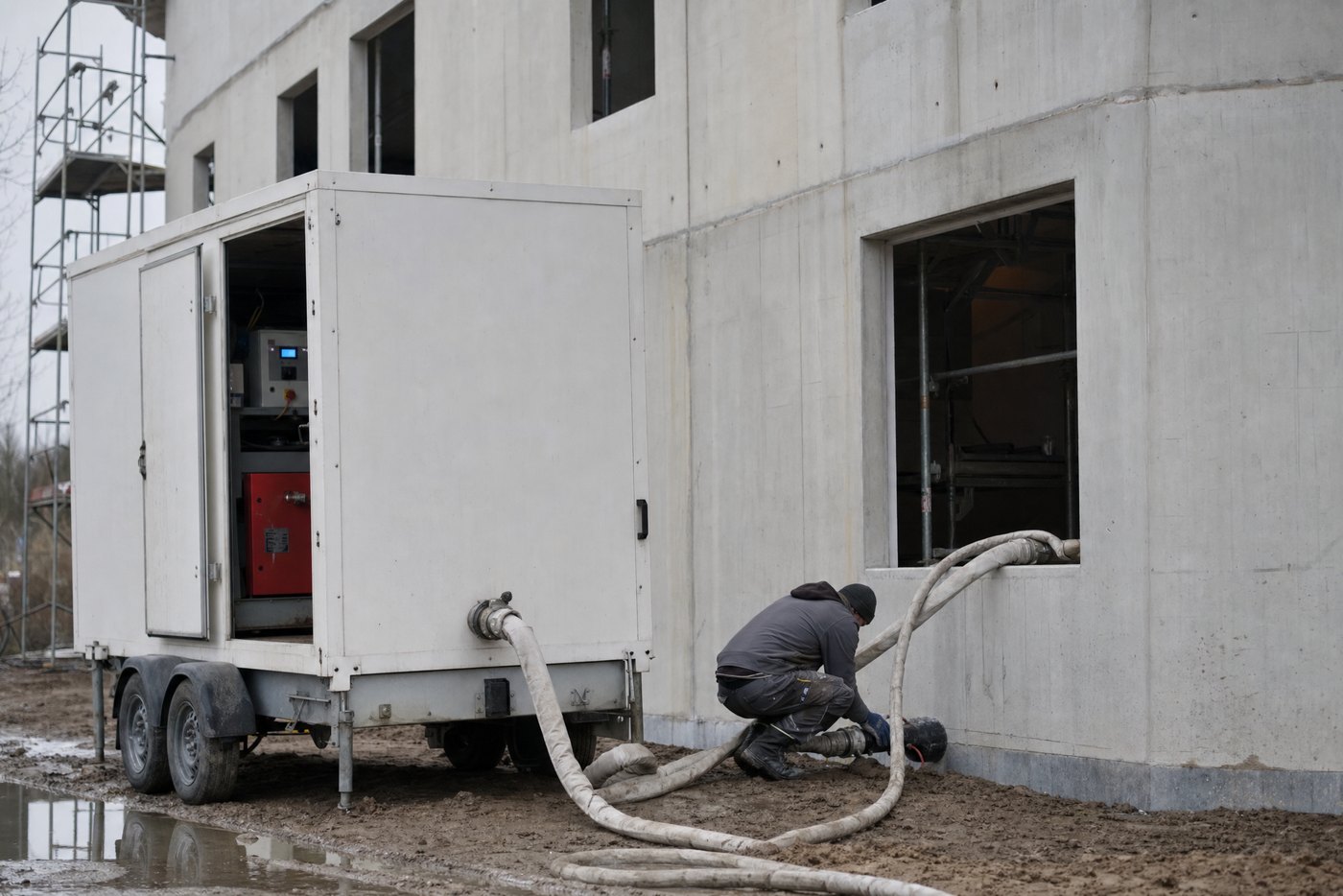
The unit is running, the hire period grows. The hire rate scale lowers the daily rate without anyone doing the maths.
A trailer, a boiler, controls and a tank first become one unit. After that it earns for years in the rental fleet. In the end it goes into sales as a used unit.
You set up your account yourself – registration opens in a new tab and needs a moment the first time. If you would rather know first whether we are a match, send us an enquiry, no obligation.
 Stock photoBuilt once, rented out many times.
Jobtura · Purchasing → Manufacturing → Rental
Stock photoBuilt once, rented out many times.
Jobtura · Purchasing → Manufacturing → Rental
Three everyday steps that cost you time today, and how they run with Jobtura:
Four points where three separate lists usually appear: in the build, at the customer, in the workshop.
An inspection template sits on the unit: which characteristics to check, which values are allowed, at what interval. Items that are due are shown before the date runs out.
The delivery note records which unit and which accessories went out. If the site needs more later, the same job gets a line item with its own date.
Missing material goes out to the supplier as an order. The delivery is scanned at goods receipt and is in stock before anyone goes looking for it on the shelf.
Accessories and alternative articles are stored on every unit and suggested in the job. That prevents the delivery where the matching hose is missing on site.
At the start there is an empty box trailer. You plan which heating unit it is to become: boiler, pumps, controls, tank, valves, connections. In Jobtura that is a job of its own of the type manufacturing, with its own quote, its own order confirmation, its own delivery note and its own invoice.
Whatever is not in the warehouse, you buy in. Several sources are stored for every article, each with the supplier article number, purchase price, minimum quantity and delivery time. The matching one is suggested during purchasing, so the price comparison needs no phone call.
Assembly and build carry their own planned dates, independent of the delivery date of the job. Scheduling works with both, and the production type controls which qualification the build needs.
At the end there is no longer a pile of bought in parts but a heating trailer that carries its own identifier as an individually tracked item.
Maybe the unit was built for a customer. Then it goes out as a new unit through quote, order, delivery note and invoice. Maybe you built it for your own rental fleet. Then it should stand at the customer as often as possible and earn turnover there.
Manufacturing, rental and sales are separate job types, each with its own document chain. They come together in the project: it bundles any number of jobs and sets costs, income and dates side by side across all of them.
Every hire line item carries its own period. The price follows from that and from the stored rate. Day factors weight individual calendar days, so weekends, public holidays and seasons are valued differently from a working day.
So the price comes out of rules instead of hand calculation, and every step stays traceable on the document, without anyone having to keep the arrangement in their head.
At some point the site is finished and the heating trailer comes back. The return records what actually comes back. Damage and late returns are held on file and can be passed on to the customer.
In the workshop, repairs and pending work run as service line items in the same job as the goods used for them. Movements between warehouse, deployment and workshop run along with them, so it is clear at any time where a unit currently stands.
Every inspection carried out produces a record with the result, the inspector and the date. If an item fails, it can be blocked and replaced by a spare unit: the order carries on, the item does not. Once released, the unit is ready again.
After a few years the sums turn around. The unit has many deployments behind it and has earned money, while the rental fleet is meant to get younger. Purchase price, average return and target residual value sit on the item, and the hire article becomes a used unit in a sales job.
Entered once, usable everywhere. No double entry.
And it carries on from there on the same job: quotes can be signed digitally, deposit, interim and final invoices follow from it, incoming payments and reminders hang on it, and at the end the data goes to the accounts.
Where spreadsheets stop, Jobtura carries on: stock levels, picking and scanning are built in. No extra tool needed.
Packing lists straight from the order. Tick off line by line, so nothing is forgotten and nothing is packed twice.
A live overview in the warehouse: which orders are due, what is packed, what is missing, on a screen right there.
Barcode and QR scanning by smartphone: book equipment, record withdrawals, check returns, in seconds.
Five quick questions, an answer straight away – then we both know whether this is a match.
Jobtura is not theory software. It has been in use for years with rental businesses, event technicians and service providers across Germany, built with the people who work with it every day.
 Stock photo
The unit is running, the hire period grows. The hire rate scale lowers the daily rate without anyone doing the maths.
Jobtura comes in two forms: as full rental software for businesses with a warehouse and equipment fleet, and as a lean cloud entry for small teams.
The full ERP software for rental, sales & service. That is this page.
Jobtura as a Service , the lean cloud entry for small teams.
And the two belong together: JaaS also works as an app alongside Sales & Rent. You can just as well use only the app, or only Sales & Rent. And where the software runs is your call: in our cloud, on your own server, or on a machine in your own building.
ERP and inventory software for Rental · Sales · Service. You start lean with what you need and add more as you grow: