In the workshop
The raw unit already has a number.
The container arrives with its own identifier and keeps it. Whatever is built into it afterwards is recorded against that same number.
A shipping container becomes a bar, a chassis becomes a special vehicle. Jobtura runs manufacturing as its own job type: material, trades, hours and serial numbers all hang on the unit that finally rolls out.
You set up your account yourself – registration opens in a new tab and needs a moment the first time. If you would rather know first whether we are a match, send us an enquiry, no obligation.
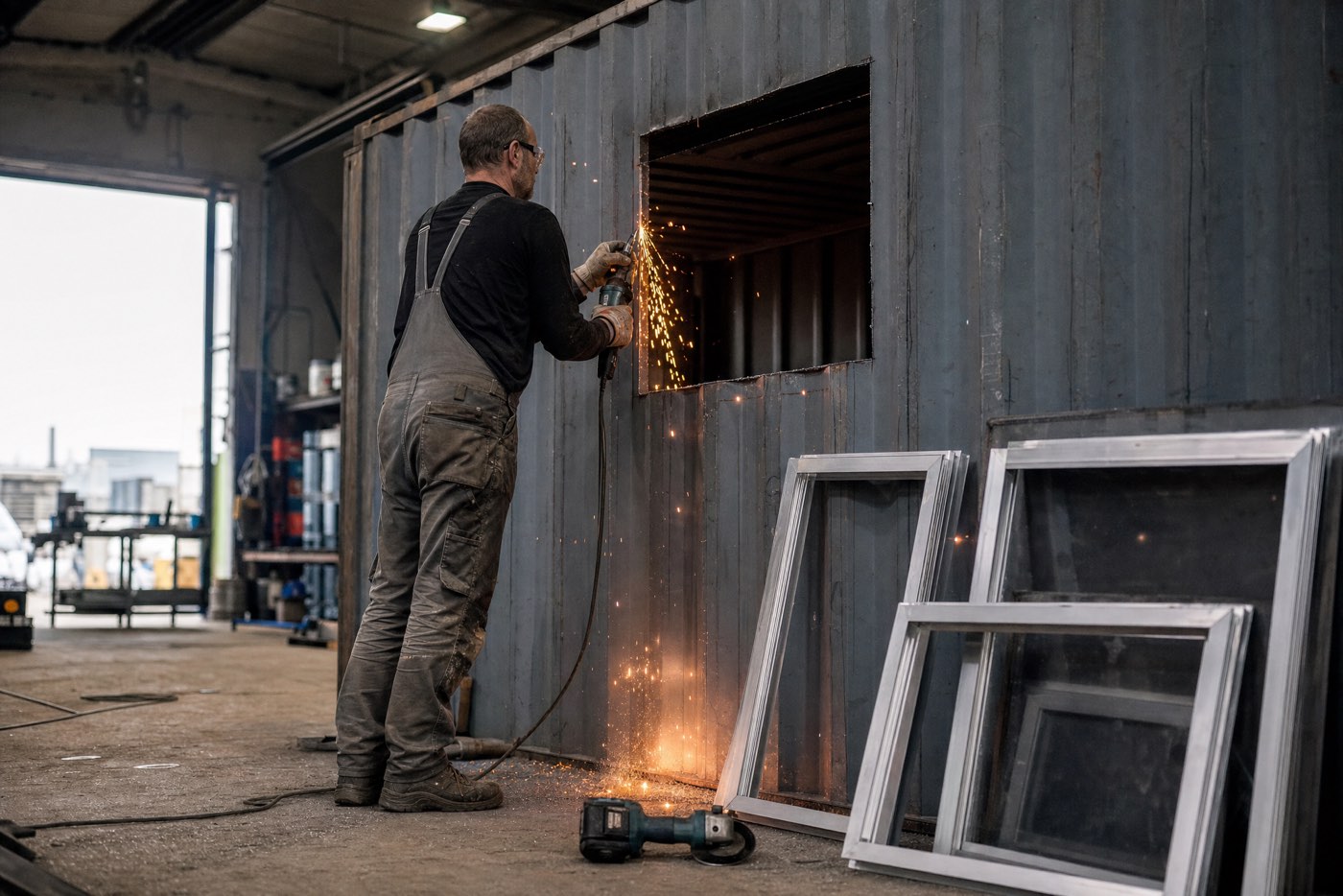 Stock photoWhat went in is recorded on the finished unit.
Jobtura · Raw unit → Costing → Purchase order
Stock photoWhat went in is recorded on the finished unit.
Jobtura · Raw unit → Costing → Purchase order
Three everyday steps that cost you time today, and how they run with Jobtura:
From raw unit to a machine with its own number, without a second list growing alongside.
Metalwork, joinery and electrical work sit in the bar chart across the period. Overlaps show up before two crews need the same day.
Purchase prices of bought-in parts and the cost per hour by trade stand next to the sales price. The margin calculation runs along before you commit.
Metalwork first, joinery in parallel, then electrics and final assembly. The steps lie across the build period rather than as one block inside it.
Like sale, rental or service. Raw unit, parts list, hours, documents and history hang on one job instead of four separate files.
A shipping container, a chassis, a trailer: the unit that is to become something is recorded with its own serial number at purchase. From then on documents, images and technical details hang on that number instead of in a folder beside it.
In Jobtura manufacturing is a job type of its own, just like sale, rental or service. The conversion therefore gets the same foundation as an order: customer, dates, line items, documents.
What is to be built can be held as an assembly with its own parts list. Doors, hatches, distribution boards, lighting and flooring are listed there as requirements before anyone orders anything.
Free attributes add whatever else your company wants to record, with no programming needed.
Before you commit there is the calculation you do for yourselves. The margin calculation shows the gross profit at the intended sales price, together with the purchase prices of bought-in parts and the cost per hour by trade.
Requirements turn into purchase orders. Every article carries several supply sources with purchase price, minimum quantity and lead time. Goods receipt books the delivery onto the manufacturing job, and the incoming invoice is created straight from the purchasing job.
Two weeks of build time are not a block but a sequence of work steps: metalwork first, the preparatory joinery in parallel, then electrics, interior fit-out and final assembly. The trades are spread across the period and appear in the bar chart over jobs and line items. Who is free and when follows qualification and availability, and approved absences take effect on staffing immediately.
If the customer changes the scope, the quotation continues in a new version. The previous state is kept on the job as a revision.
While the build runs, people book their time onto the job. At the end there is no estimate but the total hours by trade with the costs behind them.
Installed components with their own serial number stay assigned to the finished unit. Which distribution board, which generator, which controller sits in which machine can still be looked up years later through individual tracking by serial number or barcode.
The finished machine is then an article like any other. It can be sold or rented out, and rental bills by hire period and tiered rates rather than by quantity.
If you sell the unit, the customer gets the documentation as a complete production and handover folder. If it goes into the hire fleet, checklists support handover and return, and missing or damaged components are documented and then repaired or charged.
When it comes back, service starts as a job of its own on the same number. Fault and fault description are recorded on the machine, the history carries on, and whoever opens it next knows what is inside.
Entered once, usable everywhere. No double entry.
And it carries on from there on the same job: quotes can be signed digitally, deposit, interim and final invoices follow from it, incoming payments and reminders hang on it, and at the end the data goes to the accounts.
Where spreadsheets stop, Jobtura carries on: stock levels, picking and scanning are built in. No extra tool needed.
Packing lists straight from the order. Tick off line by line, so nothing is forgotten and nothing is packed twice.
A live overview in the warehouse: which orders are due, what is packed, what is missing, on a screen right there.
Barcode and QR scanning by smartphone: book equipment, record withdrawals, check returns, in seconds.
Five quick questions, an answer straight away – then we both know whether this is a match.
Jobtura is not theory software. It has been in use for years with rental businesses, event technicians and service providers across Germany, built with the people who work with it every day.
 Stock photo
The container arrives with its own identifier and keeps it. Whatever is built into it afterwards is recorded against that same number.
Jobtura comes in two forms: as full rental software for businesses with a warehouse and equipment fleet, and as a lean cloud entry for small teams.
The full ERP software for rental, sales & service. That is this page.
Jobtura as a Service , the lean cloud entry for small teams.
And the two belong together: JaaS also works as an app alongside Sales & Rent. You can just as well use only the app, or only Sales & Rent. And where the software runs is your call: in our cloud, on your own server, or on a machine in your own building.
ERP and inventory software for Rental · Sales · Service. You start lean with what you need and add more as you grow: